





Eye For Film >> Movies >> A Man Of His Time (2026) Film Review


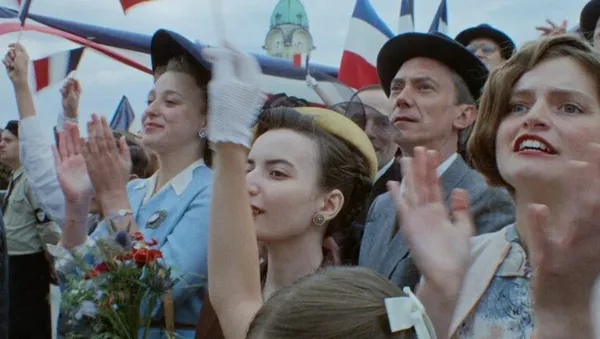

1940 - the Armistice splitting France into the Occupied Zone under German military administration and the collaborationist Free Zone headed by Maréchal Pétain establishing the Vichy government - these are known, familiar coordinates from history books and countless movies. Emmanuel Marre’s at times misguided A man of his time (Notre Salut), winner of Best Screenplay at Cannes and a Main Slate selection of the 64th New York Film Festival, plunges us into the particular and personal and what the work-life realities of a bureaucrat in the regime may have looked like. Swann Arlaud, concise and brilliant, plays Henri Marre, sharing the name with the director’s great-grandfather, whose exchange of letters with his wife, Paulette, form the backbone of the story.
Arlaud’s Marre observes, he slinks through the re-purposed spa town, rather than strides. He is all eyes, listens rather than speaks, so to better find his proper place as an aide to the poisonous endeavor. Torn between ambition and despair, constantly maneuvering to get a grip on something that spells salvation, this unexceptional man becomes our guide into the collaborative puppet state. The French title of the film refers to the thick pamphlet in praise of Pétain that Henri wrote and attempts to widely publish and spread, containing salvation through proper management.

The movie begins with a closeup of Arlaud’s somber face as people chatter and laugh all around him. It is a party, guests spiritedly mingle, exchange business cards and flirt. “If I were a flower, which would I be,” a woman asks, then “which vice?” Marre looks around, attempts a conversation with a man who introduces himself as the chief-of-staff of the Minister of Justice. Don’t show too much enthusiasm for the Maréchal, Henri is warned, or you might be taken for a double agent, as they are “chasing down Gaullists.” Food is aplenty and our protagonist shovels some from the buffet into his handkerchief to eat later. Is it “collaboration” or “cooperation”? The prattling continues as Henri downs more alcohol.
Music kicks in, catapulting us aurally 40 years into the future, an entirely unnecessary and awkward device, used two more times later in the film. The effect is clumsy as it has already become abundantly clear to anyone who has ever attended a party where they felt out of place, that what we are witnessing can not be limited to Vichy in 1940. Whereas Wilhelm Sasnal in his dream-like The Assistant or Frauke Finsterwalder in her razor-sharp and exquisitely stylish Sisi & I add commentary with their specific choices of anachronistic songs, the jump ahead here is counterproductive and a mistake, a bit like the evening gown that Henri later in the film buys for his wife to attend an important business dinner. It is neither elegant nor proper and looks desperate and out of touch.
More on the spot is the palm reading from an especially drunk man who tells Henri that he is safe and that nothing extraordinary will ever happen to him. Henri’s wife, Paulette (Sandrine Blancke), is first introduced to us as absence, in voiceover letters. She is not physically with him, but clearly on his mind, as he strolls through the spa, which has been transformed hastily for the business of the new government. Spousal frustration, past financial losses, and hopes for his book are on both their minds, not questions plaguing their conscience about new laws and inhumane practices finding foothold. The letter sign-off as his “little lady” (or “petite madame” in the original) comes across as sweet and also condescending and very much hits the tone of the era. Old-fashioned words and expressions can produce most effective time-travel sensations.
We get the job of deciphering what these often interchangeable-looking men are really saying. “We suffered too long under those elites.” Who is referred to exactly? It is to the film’s credit to not spell it out. Work environments have always had their codes. Business talks take place while the superior party is getting a massage, two mud epaulettes gracing his shoulders. Henri is looking to cement his place in the new Vichy government and the camera (cinematography by Olivier Boonjingp) appears to be searching with him for a spot to land.
Beautiful little rattan drink holders with leather straps sit on a table and whisper of a peaceful past. Hands of men in suits in close-up. The picture of Maréchal Pétain is omnipresent, promising “to protect all that are for France.” Henri offers his management advice pitch to no avail until a nighttime cat transport on a bike across the demarcation line into the German-occupied zone opens a door that will eventually lead to a job in the Ministry of Labor, where he is responsible for matters of unemployment and forced labor camps for foreign workers. Structure and evaluations, these are his skills that are exploited. In a time when literature professors have to work as coal burners to survive and everyone’s position is fragile, has looking out for others become a luxury?
More hands fill the frame, this time of women, their handbags, then faces, lipstick, as they line up on the staircase. Henri walks past them, up to his office and tells an aide to send in “the one in yellow, the one in blue, and the one with the green bag.” Would he pick the prettiest? When he asks the candidates to describe themselves after a typing test, we are in for another surprise. But the light touch and charm of the scene of choosing a new secretary is more than that. Selections of workers and grades given and futures decided, of course, also include in them the unspoken, un-shown, much larger horrors in close proximity of space and time.
At a doctor’s examination for workers’ fitness (including everything from “concrete thinking” to “teeth”) Henri advises to when in doubt put down the higher score. Workers will be needed. Times are changing. His assistant, Harpo (Harpo Guit), whose Jewish grandfather fought in the Great War, will have to be reclassified as “laborer” to remain in the office, with lower pay for the same job. At least he is safe and won’t be checked, is how Henri rationalises it. Everybody practices a loud salute to the Maréchal, who comes to town. The visit is shown through archival footage (the second instant where the choice of song, the utterly annoying Live Is Life by the group Opus, destroys all momentum of thought).
Paulette, their daughter, and two sons finally come to live with him in Limoges in a grand furnished apartment, whose provenance we can already guess at. Business at the ministry shifts. Is three workers for one prisoner a good deal? But the Germans already take a large percentage of the foreign workers. Arlaud’s facial expressions don’t give us an easy out. He is thinking, but how much this man allows himself to question what murderous regime he has become a part of, remains opaque.
One of the few scenes that involves direct contact with the Nazi occupiers takes place in the garden of an idyllic farmhouse. Chickens wander about, the officers sit in what are clearly the owners’ best armchairs, countless wine bottles on the table, they discuss with Henri how many hundreds of Spaniards and Portuguese to take, as the farmer’s wife serves them tarte aux pommes. They merely chuckle at the wish of a promise to leave the French workers alone. Marre is their willing puppet.
The sun glares over the house and the trees serves as reminder that the same light is shining then and now.
Stress is mounting, trucks, liters of gas, an operation involving women and children. It is August 1942. Family life goes on, a relaxing picnic, a stroll by the river. Jonathan Glazer shows Auschwitz Commander Rudolf Höss and his family in just such a scene in The Zone of Interest. Mundane life continues right next to atrocities.
A dinner at the Prefect’s house, whose wife turns out to be an old school friend of Paulette’s, makes several strands of the film collide. Paulette is the toast of the party, the promises of her past and the life not lived revealed. Henri looks on, as usual, stone faced, seemingly uninvolved (for the third and final time an anachronistic number, the electronic Popcorn song, interrupts for a silly dance break we do not need). At the end of the night, Henri is being thanked for the successful “removal operation.”
The work camps have to be cleared to allocate Jews. Trucks are in town. 60 tanks. An order of straw and chamber pots becomes a crucible. And Henri continues to function as powers are shifting. He is to report about his former boss, by the man who now takes over his own position. At the cinema with his wife to watch Jean Delannoy’s The Eternal Return (screenplay by Jean Cocteau, starring Jean Marais), Henri is warned by Harpo that the resistance is after him. There exists no safe ground when you are part of a regime that uses fear and threats as casual tools.
In January 1944, Henri gives a speech about strong order, rebuilding together. Does he still believe in the crimes he is committing under the Vichy government? While in Paris, he writes to his wife how great it feels to speak in front of 200 prominent Frenchmen. The conference is timed with the breaking news that “supposedly the Americans landed in Normandy.”
Ultimately, Henri is left stranded in the countryside with a young boy in his care, a stranger left by the child’s desperate mother. Nietzsche’s take on the Eternal Return asks the question: What would you do if you had to relive your life in exactly the same way over and over again?
Inventors of rules have their enforcers; individual human decisions make up the machinery of a society. When does obedience turn deadly? Chaos is easily weaponised. Chop up responsibilities and people will feel as though their “little evil” doesn’t matter. How small an act does it take to start rotting a soul?
Reviewed on: 21 Sep 2026


Director: Emmanuel Marre
Writer: Emmanuel Marre
Starring: Swann Arlaud, Sandrine Blancke, Mathieu Perotto
Year: 2026
Runtime: 155 minutes
Country: Belgium, France
Search database: